Experts and business leaders call for a more sustainable economy and responsible consumption
2 December de 2024
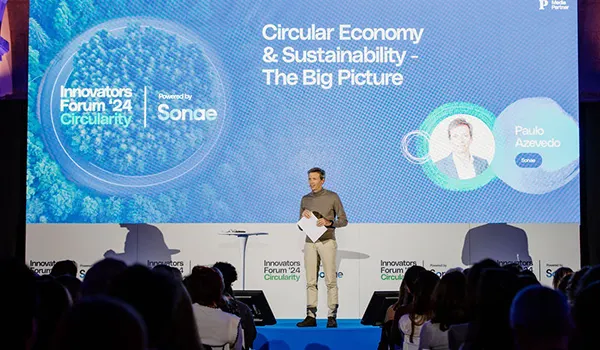
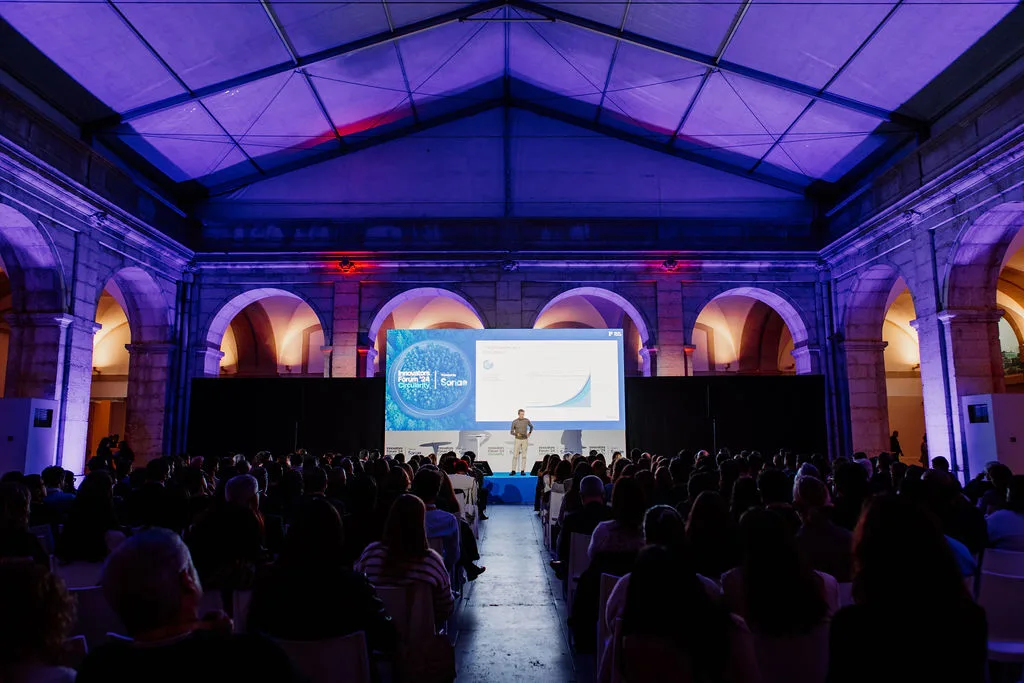
Governments and companies need to accelerate their commitment to circularity to build a more sustainable economy. Simultaneously, individuals must adopt more responsible consumption habits. These were two key conclusions from the Innovators Forum '24 Circularity, an event developed by Sonae, which brought together over 700 participants and speakers from Portugal and internationally in Lisbon to discuss circularity.
· Only 7,2% of the global economy is circular, and the trend is decelerating.
· The circular economy could grow fivefold by 2040, generating 820 billion € in revenues.
· The Innovators Forum ‘24 Circularity gathered over 700 participants and speakers from Portugal and abroad.
· Organiseb by Sonae, the event debated the current state of the economy and explored paths to innovation and positive impact.
Governments and companies need to accelerate their commitment to
circularity to build a more sustainable economy. Simultaneously, individuals
must adopt more responsible consumption habits. These were two key conclusions
from the Innovators Forum '24 Circularity, an event developed by Sonae, which
brought together over 700 participants and speakers from Portugal and
internationally in Lisbon to discuss circularity.
According to
data presented at the conference, only 7.2% of the global economy is circular —
a concerning figure, especially as it marks a decline from 8.6% in previous
years. The Circle Economy Foundation, whose CEO, Ivonne Bojoh, participated in
the forum, attributed this deterioration to population growth and the excessive
exploitation of natural materials. She emphasised the need for innovation and
collaboration to redesign economic systems. "The circular economy isn’t just
about recycling; it’s about innovation throughout the entire value chain,” she
said.
Cláudia Azevedo,
CEO of Sonae, highlighted that circularity is a critical path to ensuring a
sustainable future and is both a global and local imperative. "In the past six
years, more resources have been extracted than in the entire last century. More
needs to be done [to increase circularity],” she stated. Azevedo further
emphasised that circularity is a strategic pillar for Sonae because "there’s no
good business on a bad planet.” Since 1995, Sonae has advocated for integrated
environmental management in business, promoting and implementing best
practices.
Paulo
Azevedo, Chairman of Sonae, reinforced the message by calling for responsible
consumption. "We need to stop turning [the world] into pollutants and waste and
instead transform it into useful things. We need to use less,” he said, adding,
"[At Sonae] we aim to thrive in a sustainable world, not in an unsustainable
one.”
Urgent
Measures Needed to Promote Circularity
The second
edition of the Innovators Forum, streamed online from Lisbon to a global
audience, also featured speakers such as Gunter Pauli (economist and
sustainability expert), Cláudia Azevedo (Sonae), Raphaël Masvigner (Circul’R),
Marta Brazão (Circular Economy Portugal), Ana Barbosa (IKEA Portugal), Sónia
Cardoso (Sonae), Filipa Pantaleão (BCSD Portugal), and Anders Åhlén (McKinsey
& Co).
Gunter Pauli
urged entrepreneurs to think outside the box and view circularity as an
opportunity for diverse business models. "We need entrepreneurs who make a
difference. We need action on the ground, and we need to accelerate [circular
business models],” he concluded, "Never, as entrepreneurs, lose the hope of
inspiring a future customer.”
Bernd
Halling, Head of Policy and Outreach at Re-imagine Europe, noted that the
European Commission’s circular economy legislation "has yet to be widely
adopted” by member states. He warned that political changes in the European
Parliament could affect the effectiveness of new initiatives, citing concerns
about collaboration among commissioners and the potential for misleading
narratives that hinder understanding and acceptance of circular economy
proposals.
Raphaël
Masvigner, co-founder of Circul'R, stressed that the "circular economy is a
fundamental tool for mitigating risk” in businesses, especially as "natural
resource shortages will lead to many shocks.” Masvigner highlighted the need
for better product design, which can reduce up to 80% of a product’s impact. He
also emphasised the importance of promoting reuse and repair as shorter, more
efficient circular economy cycles compared to recycling.
Speakers
agreed that transitioning to a circular economy requires coordinated efforts
among governments, businesses, and consumers. Recommended strategies included
public policies incentivising sustainable practices through subsidies, the
creation of universal metrics to measure impact, and investment in business
models based on reuse and repair to ensure financial and environmental
sustainability. Consumers, in turn, should prioritise durable products with a
reduced environmental impact. In a world nearing its planetary limits, the
circular economy is a necessity, not a choice.
Balancing
Environmental, Social, and Economic Value
Implementing
a circular economy will bring environmental, social, and economic benefits.
Anders Åhlén from McKinsey estimated that circular business models could grow
fivefold by 2040, generating €820 billion in revenues and creating new markets
driven by advances in artificial intelligence and biotechnology. "We cannot
wait. We need to act now to ensure a sustainable future,” Åhlén emphasised.
At Sonae,
this commitment has already generated approximately €90 million in revenues
from circular products and services in 2023, contributing directly to positive
environmental and social impact. Additionally, Sonae’s retail businesses have
recovered 85% of waste and reduced single-use plastic consumption. By the end
of 2023, 86% of the plastic packaging used in private-label products was
recyclable, and MC’s "zero waste” initiatives have prevented food waste worth
€66 million.
Sonae’s
investment in the circular economy is fostering innovative business models and
projects that enhance the group’s sustainability while positively impacting the
community environmentally, economically, and socially. Initiatives such as
electronic equipment repair, clothing recycling, and second-hand or bulk
product sales are among the new business models strengthening Sonae’s circular
activities and benefiting society.
The Innovators Forum ’24
aims to inspire and drive innovation, giving leaders from across sectors a
platform to explore trends, challenges, and opportunities, fostering a
community united by the circular and regenerative economy movement.
To ensure the benefits
of progress and innovation are accessible to all, the event is free for
students and NGOs, with initial payments refunded after participation. Online
streaming is free to all upon registration.
The Innovators Forum ’24
underlines Sonae's commitment to innovation, offering a platform for knowledge
sharing and reflection on the challenges and opportunities facing Portugal,
with the potential for positive impact nationwide and globally.