
Sonae//Serralves project presents new exhibition by Haegue Yang
21 June de 2016
21 June de 2016
Sonae and Serralves Foundation have come together to introduce the Portuguese audience to a new exhibition by South Korean artist, Haegue Yang. This is an initiative of the Sonae//Serralves Project, which aims to promote culture and bring communities closer to the Arts. Unique in Portugal, this project is responsible for granting the national audience a first contact with the artist’s work, who is nowadays widely internationally renowned.
An Opaque Wind Park in Six will be open to the public at the magnificent gardens of the Serralves Museum until 4 June 2017.
Ângelo Paupério, Co-CEO of Sonae, comments, "Sonae pursues within its mission the purpose of contributing to promote the social and cultural wellbeing of the communities where it operates. The Sonae//Serralves Project is a successful example of this commitment, allowing to present national and international artists of great value in Portugal, a fact that has been recognized by a wide public participation. Furthermore, this initiative also contemplates a more open and closer approach to the academic world, namely by involving art students who assisted the artist in the elaboration and implementation of the pieces, together with the open sessions held with the artist at four Portuguese universities”.
Suzanne Cotter, Director of the Serralves Museum of Contemporary Art, commented on Haegue Yang, "The poetic expression of the contemporary cultural states present in Yang’s work, combined with her ability to create pieces at an ambitious scale that speak to us through time and space, make her a mandatory choice for the Sonae//Serralves Project. This project represents an important step in the artist’s expression and her installation in the Serralves Park will shed a new light on how artists can not only intervene in our everyday surroundings, but also use their work to express more profound and less visible realities”.
A commissioned work with the participation of the community
Invited by the Sonae//Serralves Project, Haegue Yang developed An Opaque Wind Park in Six Folds specifically for the Serralves Park, in close relationship with the community.
The artist relied on the support granted by Serralves and a local production team of three Fine Arts Portuguese students, chosen through a competition, together with an architect, engineers, builders and gardeners.
As part of the project, Haegue Yang also held a series of open talks at the Fine Arts Faculties of Oporto, Lisbon and Coimbra, introducing her artistic thought and sharing her knowledge with young national artists.
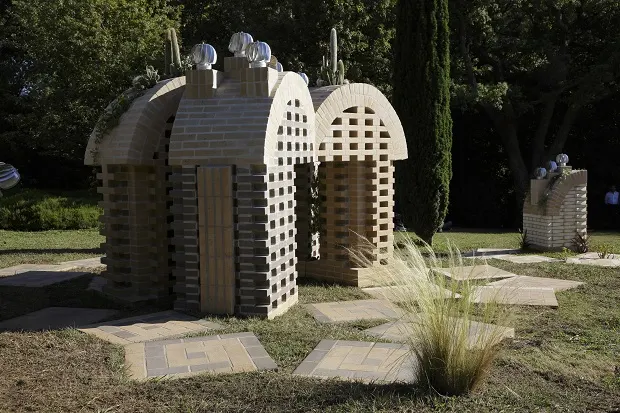
An Opaque Wind Park in Six Folds is composed of five partially arched towers of different dimensions, built in brick and connected by the geometric arrangement of paving stones. This ambitious sculptural project, occupying a 70 m2 area in Clareira dos Teixos, set in a central part of the Park between the Museum and the Villa, is an invitation for viewers to stroll through the hybrid landscape of its multiple structures.
Yang’s sculptural approach uses the Islamic symmetric geometry, particularly the hexagon, created by subdividing the circle in six equal parts, or portions, that serve as the basis of the decorative pattern. In order to conceive An Opaque Wind Park in Six Folds, Yang used 72 x 72 cm square units for said subdivisions. Each of these square units limits the space covered by the slabs and towers of varying heights that form the structural architecture of this work. The towers are built in clay bricks of three different colours. The primary colour is yellow with different shades of light pale grey or a darker tone of grey, resulting in an ornamental facade or surface. There are aluminium turbine vents on top of the towers and fitted into the complex built by Yang there is a bathtub for birds and several species of plants and vegetation, including succulents, ivies and grasses, that are intended to grow, creep, flower and eventually die throughout the 12 months this commissioned piece will remain in the gardens of Serralves.
The choice of brick as the chief material of this piece reflects the artist’s interest in different stories of industrial production and associations with stability and universality. The use of geometry derives from Yang’s interest in scales and standardized shapes, which first came to light in Grid Bloc, the paper collages made of stationery items she began to produce back in 2000. Pursuing her curiosity for the functional and aesthetic possibilities of standardized units, Yang subsequently used the mathematic basis of Grid Bloc as a starting point to produce big dimension installations using everyday materials, such as blinds, which eventually multiply into impressive suspended structures, as if they were transported by air itself.
An Opaque Wind Park in Six Folds abstains from a monolithic statement in favour of the living structure that merges the constructive and aesthetic application of mathematics with the organic cycles and the transformations of the natural world. The aluminium turbine vents that top Opaque Wind Park in Six Folds embody the movement of air and wind, sensorial elements that are constant in Yang’s installations. Inspired by the wind towers usually used in buildings in the Persian and Arabian Gulf, Yang first used these standard structures in An Opaque Wind at the 12th Sharjah Biennale, in 2015. Integrated within the towers’ decorative plan, they become sparkling kinetic elements used by the artist as a metaphor for migration and transitory encounters. Their importance in the tower, brick, vegetation and wildlife complex confirms the piece as an expression of communities and inter-relationships needed for coexistence in a global age.
Previously, Haegue Yang created big dimension pieces for the South Korea Pavilion at the 53rd Venice Biennale in 2009, for the Kunsthaus Bregenz in Austria, for the Leeum, Samsung Museum of Art of Seoul, in Korea, and for the Ullens Center for Contemporary Art, in Beijing. Among her most recent large scale commissioned pieces are Approaching: Choreography Engineered in Never-Past Tense, the vast kinetic installation made of blinders built at the former train station of Kassel, in Germany, for the Documenta 13 in 2012; and also An Opaque Wind, a sculptural intervention outdoors produced in 2015 for the 12th Sharjah Biennale, in the Sharjah Emirate of the United Arab Emirates. As of now, Yang is preparing a new installation with blinders to be presented this summer at the Centre Pompidou, in Paris.
The Sonae//Serralves Project is curated by Suzanne Cotter, Director of Serralves Museum of Contemporary Art, assisted by curator Marta Moreira de Almeida.
ARTIST BIOGRAPHY
Born in South Korea in 1971, Haegue Yang lives and works between Berlin, Germany, and Seoul, Korea, teaching Fine Arts at the Malmö Art Academy, in Sweden. The artist has had her projects and exhibitions on show in prominent institutions, such as in Leeum, Samsung Museum of Art, Seoul (2015); Bergen Kunsthall, Bergen (2013); the Museum of Modern and Contemporary Art, Strasbourg (2013); Haus der Kunst, Munich (2012); The Tanks at Tate Modern, London (2012); Aspen Art Museum, Aspen (2011); Arnolfini, Bristol (2011); New Museum, New York (2010); and Walker Art Center, Minneapolis (2009). Yang also participated in Documenta 13, Kassel (2012) and in exhibitions at the Institute of Contemporary Art in Boston (2013), the Museum of Modern Art, New York (2015) and the Solomon R. Guggenheim Museum, New York (2015). Haegue Yang represented South Korea at the 53rd Venice Biennale, in 2009.
See PDF